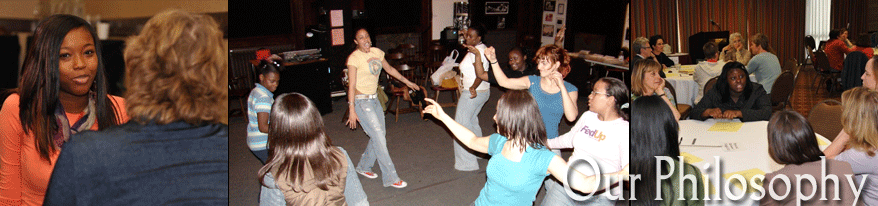
"When we are together as a group, the unity we have,
the love that we share, there is nothing like it.
It's like a getaway from our every day life,
because the things that we have to go through living where we live,
and seeing what we see from time to time...
you need a place where you can relieve your stress
and feel like well, there is somewhere where I can go and feel a little safe,
and feel that it is not the end of the world,
I can get out of where I am at, I can go to college,
I can do some things other people say you can't do."
Shalante Townsend, 2007 Girls on the Move graduate
Our Philosophy, Values, and Purpose
In the Girls on the Move Project, we encourage girls to go on a moving journey of
self discovery through the arts to confront painful experiences, combat oppression,
and celebrate cultural diversity. Girls go through a transformational phase of improved
self esteem and educational motivation by applying newfound leadership abilities, and
transforming their creativity and passion into healing the community and one another
thorugh peer-mentorship. Our goal for girls in the program is that they find their passion,
power and purpose and share it with the world!
The ultimate purpose of Girls on the Move is to use the creative and performing arts to
empower girls living in at-risk communities to become visionary leaders of change in
their own lives and in their communities, by transforming themselves from the inside
out. As girls step into their leadership abilities, and inspire others by improving their
self esteem, social skills, and academic motivation, and use their creativity, passion and
vision to help heal their communities; they will be helping not only themselves, but also
their peers, families and communities to transform the destructive, multi-generational
effects of Anomic Depression.
Anomic depression is a chronic state developed during long term exposure to traumatic conditions. This prevalent condition today negatively impacts adolescent development
including:
- Feelings of defeat, lowered self-esteem, fear
- High risk behaviors – aggression, substance abuse, early pregnancy
- Resistance – low motivation in school
The Girls on the Move project's unique structure was designed based on four concepts drawn from
the masters' thesis research of Moving Creations' Founder, Emily Nussdorfer into the causes of
youth violence and community decline, and reparative factors that can transform these destructive
forces. From her investigation of gender-based adolescent developmental theory, feminist relational
theory, anthropology, sociology, creative arts therapy, and community psychology, these 4 key
reparative factors to transform anomic depression amongst youth were identified:
- Interdependence: The individual is inextricably linked to her/his community.
- Synergy: Sharing resources so that power is shared by all
- Mutual Empowerment: Girls empowering each other to become leaders
- Creative Artistic Transformation Processes: The therapeutic use of art forms to
promote personal, gender and cultural identity healing and repair, transform pain into
power, and develop leadership abilities.
These concepts are showcased in the Girls on the Move project using six key
creative art forms picked specifically for our target population of adolescent girls to
therapeutically facilitate the Creative Transformation of anomic depression. To support
the healthy identity development of the girls from the underserved communities we serve,
we utilize: put the hands with art forms within it under here.
- Dance to safely channel aggression and sexuality, uplift depression, build health, self
esteem and team spirit.
- Poetry to vocalize feelings of depression/rage, to inspire pride in racial and cultural
identity, and to articulate dreams and hopes for the future,
- Fashion Art to promote healthy female body image and to celebrate personal and
cultural identity,
- Theater to cathartically rework negative identifications and as a therapeutic
educational process to build positive team spirit, develop conflict resolution skills and
foster individual initiative, mastery and self esteem,
- Mask Design/Character Dance Choreography to develop and try on more positive
and powerful identifications through character creation
- Documentary Filmmaking, to ground the girls in their new sense of self and purpose
into the wider community.
Each of these artistic activities is linked to a specific therapeutic/educational
transformative process, and at the core of each process is a new definition of
empowerment. By the end, through collaborating with each other in a long-term creative
effort, the girls find "a way of being in relationship that simultaneously enhances the
power of the other and one's own power," and develops a "relational context where
mutual power is encouraged and facilitated"
Girls in Action – Creative Transformation & Empowerment
We believe that the special nature of the Girls on the Move project lies in the emphasis
on Creation as a form of agency and draws upon relational feminist theory regarding
the unique need for girls and women to have Agency in Community. The girls lead the
way in the development of each artistic endeavor, become a team during the process,
and discover that their weaknesses are turned into strengths as the group learns to
support each other. We engage the particular communities surrounding each girl by
encouraging their attendance to every performance and enlisting their future support for
the participant's goals and visions.
Our program is also unique in the degree to which it tailors itself to the needs of
each group. Girls often enter the program mistrustful, shy and reluctant, so we offer a
wide range of activities to make sure that every girl is able to find one that brings out
her creative voice. We make sure to showcase at least 2 art forms during each workshop,
including a dance or theater-based trust building warm up. Every week the participants
journal about the programming, and we tailor future weeks around how they respond to
the art presented.
The performance itself is another transforming agent; afterwards, girls speak of how
proud they were of themselves, how happy they were to have achieved success and to
have an audience appreciate them. Family members note changes in the girls from the
beginning to the end of the program. One grandmother wrote after the performance was
over, "As a result of your program my 3 grandchildren have shown more confidence in
themselves."
Our Goals for Girls on the Move!
- Inspire a lifelong journey of self discovery, learning & growth
- Curb truancy, youth violence, academic failure, and high-risk behavior
- Empower visionary leaders of positive change
- Develop positive identity & relationships, celebrate diversity
- Heal effects of Anomic Depression, transforming pain into power
|